PhotoZoom Classic 9.0.2 Review – Still the Best Image Upscaler?
S-Spline Max AI brings the muscle, but batch processing isn't invited to the party.
Benvista PhotoZoom Classic : Version 9.0.0
Introduction
You know that sinking feeling. A client sends over a thumbnail-sized logo they want blown up for a banner, or you dig up an old photo from your phone that looks fine on screen but turns into a pixelated mess the moment you print it.
That’s the specific headache Benvista PhotoZoom Classic has been solving for years. Version 9.0.2 takes the company’s patented S-Spline scaling technology and layers machine learning on top of it, creating what they call S-Spline Max AI.
This review covers how PhotoZoom Classic 9.0.2 performs in everyday use, where the S-Spline Max AI engine earns its keep, and the one feature omission that might make you consider the Pro version instead.

Overview
PhotoZoom Classic 9 is a dedicated image resizing utility from Benvista Ltd., a software company that has been refining enlargement technology since the mid-2000s. Unlike general-purpose photo editors that treat resizing as an afterthought, PhotoZoom is built for one job: scaling images up or down while preserving as much detail as mathematically possible.
The Classic edition is the standalone application aimed at users who don’t need Photoshop plug-ins, Lightroom integration, or batch processing. It handles common image formats JPEG, TIFF, PNG, BMP, and even RAW files from digital cameras and can theoretically output an image up to one million by one million pixels. For context, that’s about a gigapixel, far beyond what any practical print job would ever require.
Searchable phrase: Overview of PhotoZoom Classic 9 features and capabilities
🔥 You May Also Like
4DDiG Duplicate File Deleter 3.0.0.28 PC Software
Description
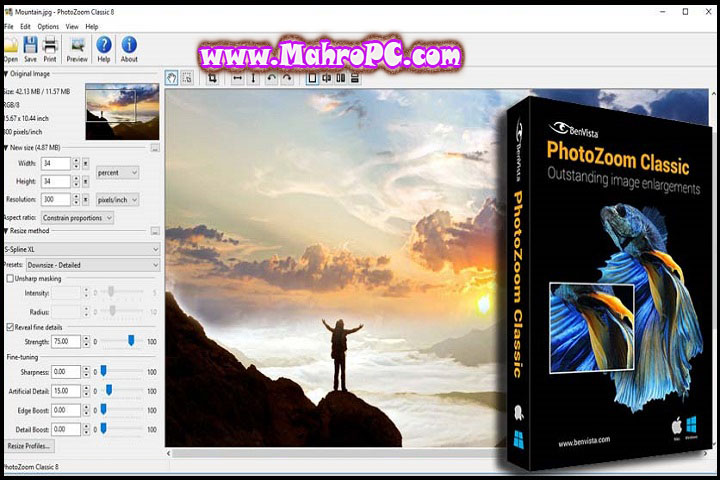
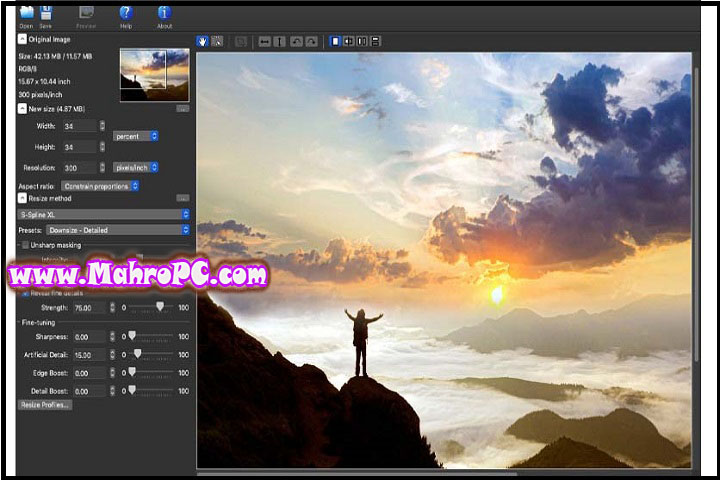
So how does the software actually work under normal conditions? You open an image, punch in your desired dimensions or scale percentage, select a resize method, and let the engine process. That’s the surface-level workflow. What’s happening behind the scenes is more interesting.
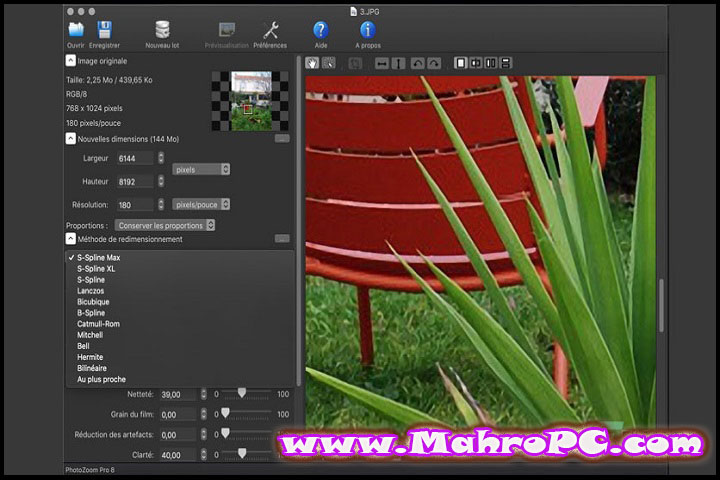
Traditional interpolation methods like Bicubic or Lanczos look at neighboring pixels and compute a mathematical average. S-Spline Max AI, by contrast, is adaptive it analyzes the sharpness, texture, and structure of the original before deciding how to reconstruct each area at the larger size.
Where this pays off is in edge preservation. Enlarge a photo with a standard algorithm, and straight lines develop a soft halo effect. With S-Spline Max, edges stay crisp without looking artificially sharpened.
Now for where it falls short: batch processing doesn’t exist in the Classic edition. You read that right. If you have 50 product photos that all need the same resize treatment, you’re doing them one at a time.
Searchable phrase: Detailed description of PhotoZoom Classic 9 functionality
🔥 You May Also Like
Approximatrix Simply Fortran 3.35.4225 PC Software
Key Features
S-Spline Max AI Resize Engine
This is the headline feature that separates PhotoZoom from basic image editors. The AI-powered engine doesn’t just stretch pixels it reconstructs textures intelligently. Enlarging a 600px-wide photo to fit a 4K monitor (3840px) meant the algorithm needed to invent roughly 85% of the pixel data.
Split-Screen Preview
Before committing to a full render, you can preview the enlargement method in a side-by-side view. This matters because the “best” preset isn’t universal a preset optimized for landscape photos might over-sharpen a portrait. The split-screen lets you cycle through methods and see the difference on a zoomed-in portion of the image before processing the whole file.
Advanced Fine-Tuning Controls
Beyond the automatic presets, the software gives you sliders for edge sharpness, artifact reduction, and film grain simulation. These aren’t just cosmetic toggles adjusting sharpness for specific image types makes a genuine difference.
Cropping Tools for Close-Up Enlargements
The built-in crop tool lets you select a specific region and enlarge just that portion. If you have a group photo and need a high-resolution crop of a single person’s face, this keeps the workflow contained without bouncing between separate software.
Searchable phrase: Key features of PhotoZoom Classic 9 you should know
How to Install
-
Run the installer. Windows SmartScreen may display a warning since the software comes from an independent publisher that’s expected behavior. Verify the digital signature belongs to BenVista Ltd. before proceeding.
-
The installation wizard is straightforward. Accept the license agreement and choose your installation directory. Defaults work fine for nearly all setups.
-
[Screenshot placeholder: Installation wizard with destination folder selection]
-
Launch PhotoZoom Classic 9 after installation completes. You’ll see a clean workspace with a prominent “Open Image” button and resize settings panel on the right side.
-
[Screenshot placeholder: First-launch interface with empty workspace]
-
Before processing large files, go to the Preferences menu and enable GPU acceleration if your system has a dedicated graphics card. This can speed up processing significantly — Benvista claims up to a 5x improvement with GPU support active.
Tip: If you’re enlarging a very large file (say, a 50MP RAW to its maximum supported dimensions), close other memory-hungry applications first. S-Spline Max AI is computationally intensive, and the software can slow to a crawl if your system starts swapping to disk.
Searchable phrase: *Step-by-step installation guide for PhotoZoom Classic 9*
System Requirements
| Component | Minimum | Recommended |
|---|---|---|
| Operating System | Windows 10 (64-bit) | Windows 11 (64-bit) |
| Processor | Intel or AMD compatible, 1 GHz | 2 GHz quad-core or higher |
| RAM | 4 GB | 8 GB or more |
| Free Disk Space | 150 MB for installation | 500 MB+ for processing large files |
| Graphics | DirectX-compatible video card | Dedicated GPU with 2 GB+ VRAM for acceleration |
| Internet | Required only for download and activation | Broadband |
*PhotoZoom Classic 9 also runs on macOS (64-bit, including Apple Silicon via Rosetta 2). The software is compatible with 32-bit and 64-bit environments, though 64-bit is strongly recommended for handling large images.*
Searchable phrase: System requirements for PhotoZoom Classic 9 on Windows
🔥 You May Also Like
Adobe Substance 3D Sampler v4.5.0.4785 PC Software
Download Information
-
Current Version: 9.0.2
-
File Size: 121 MB
-
Release Date: 2026
-
Download Format: Executable installer (.exe) for Windows
-
Operating System: Windows 10, Windows 11 (64-bit), macOS
Important:Download PhotoZoom Classic 9 only from the official website. After downloading, right-click the installer file, select Properties > Digital Signatures, and verify the publisher signature. Always scan downloaded files with an up-to-date antivirus before running them.Avoid cracked or repackaged versions — they frequently carry malware and lack support for updates.
FAQ
How much better is PhotoZoom than Photoshop's built-in resizing?
For enlargements above roughly 150% of the original size, the difference is immediately visible. Photoshop's Bicubic smoother produces soft edges and a slight blur. PhotoZoom's S-Spline Max AI keeps lines crisp and textures intact. .
Does Classic support batch processing multiple files?
It doesn't. That's one of the key features locked behind the Pro edition. If you regularly need to resize dozens of images in one go, the Classic version will frustrate you quickly.
Can it fix genuinely bad, low-resolution source images?
To a point. If the source image is heavily pixelated or compressed to death, the AI can smooth blocky artifacts and sharpen edges, but it can't reconstruct detail that was never captured. A 240p frame from an old video will look cleaner after processing, but it won't suddenly look like HD footage.